

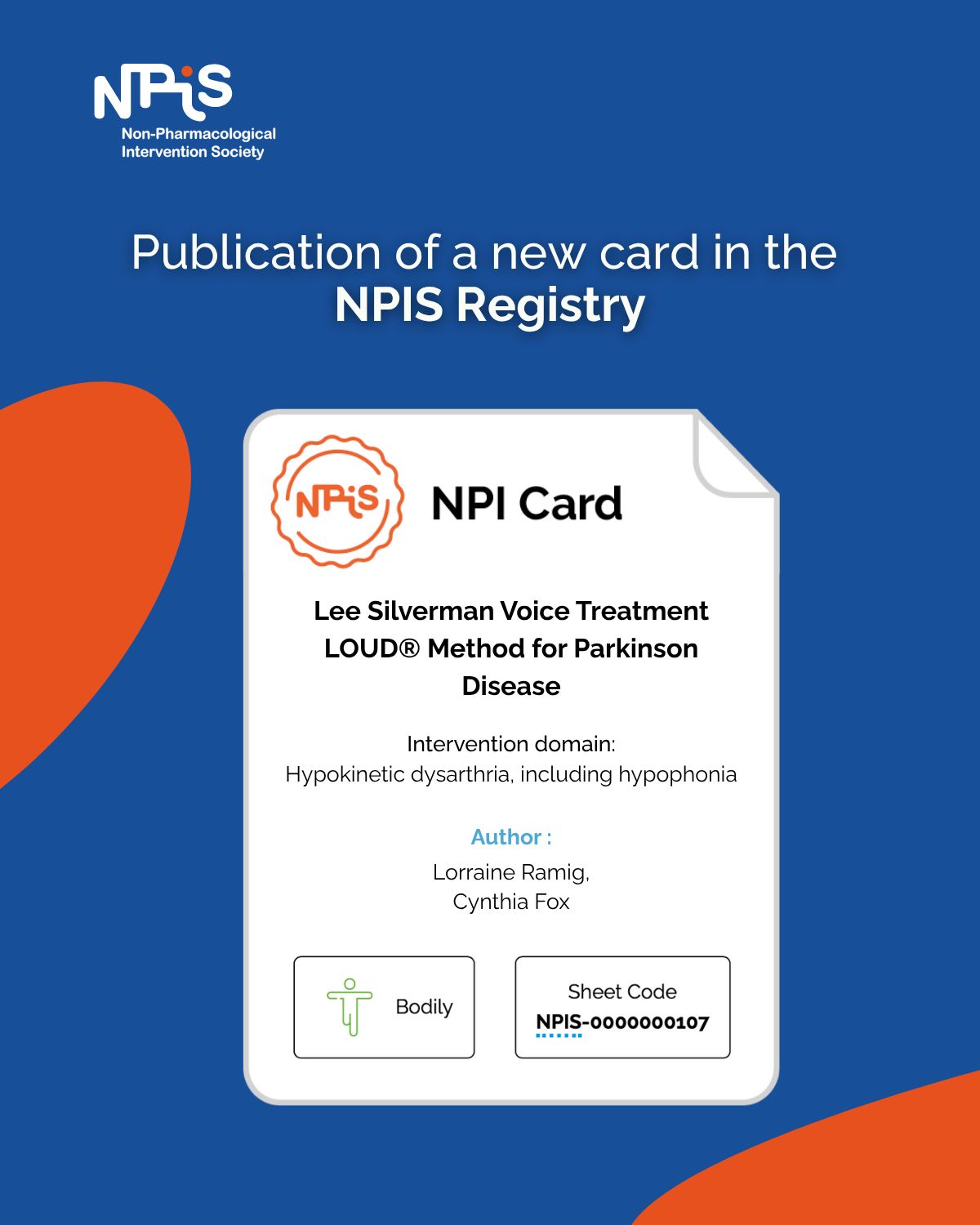
In an ongoing process of structuring and disseminating non-pharmacological interventions (NPIs), the NPIS Registry is being enriched with a new card on the Lee Silverman Voice Treatment method – LSVT LOUD®, intended for people living with Parkinson’s disease.
This intervention, coming from the field of speech therapy and developed by Cynthia Fox (PhD, CCC-SLP, University of Arizona) and Lorraine Ramig (PhD, CCC-SLP, Purdue University), is based on a structured vocal rehabilitation protocol. It mobilizes specific exercises of phonation and breathing aimed to improve the intensity of the voice and the intelligibility of speech, with the aim of sustainably supporting communication and autonomy for those concerned.
Like all the cards in the Registry, this one is based on a rigorous scientific framework and offers a standardized description of the intervention, structured around three complementary components: information accessible to users, an operational framework for professionals and an analysis of impacts for funders.
Freely accessible online, this new card helps to strengthen the traceability and recognition of speech therapy practices in the field of NPIs. It is part of the NPIS' ambition to build an evidence-based, evolving international knowledge base.
This intervention, coming from the field of speech therapy and developed by Cynthia Fox (PhD, CCC-SLP, University of Arizona) and Lorraine Ramig (PhD, CCC-SLP, Purdue University), is based on a structured vocal rehabilitation protocol. It mobilizes specific exercises of phonation and breathing aimed to improve the intensity of the voice and the intelligibility of speech, with the aim of sustainably supporting communication and autonomy for those concerned.
Like all the cards in the Registry, this one is based on a rigorous scientific framework and offers a standardized description of the intervention, structured around three complementary components: information accessible to users, an operational framework for professionals and an analysis of impacts for funders.
Freely accessible online, this new card helps to strengthen the traceability and recognition of speech therapy practices in the field of NPIs. It is part of the NPIS' ambition to build an evidence-based, evolving international knowledge base.
Other articles that might interest you